TRAIBE ← Library
Notes / The Valley5 min read

95% of AI pilots don’t pay back.
What do the 5% do?

Six findings from the MIT report, and four stories that show them in practice.

Raoni LotarOctober 2026
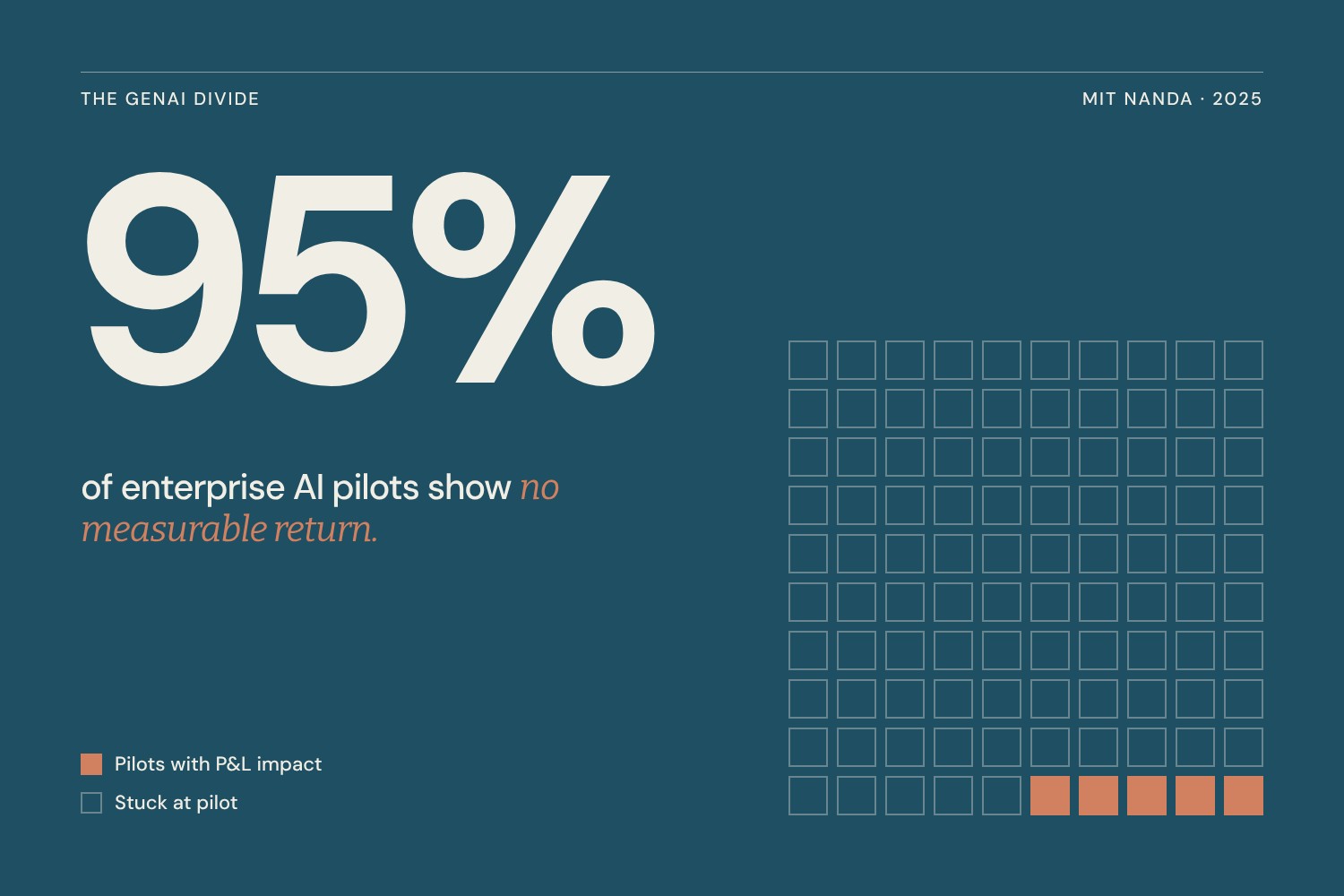
95% of enterprise AI pilots show no measurable return: a grid of 100 squares with only 5 filled
Only 5 in 100 pilots reach the P&L. Source: MIT NANDA, The GenAI Divide, 2025.

A 2025 MIT study found that, despite $30 to 40 billion invested in enterprise generative AI, 95% of organisations are getting zero measurable return on their P&L. The problem, it says, is rarely the model. It is how companies put AI to work.

Inside the studyMIT NANDA · July 2025

The headline only tells half the story. The report also follows companies from first test to real results, and explains what separates the few that make it. Here is the funnel, followed by the six findings that matter most.
Custom and vendor AI tools · share of organisations
Evaluated
60%
Reached pilot
20%
Reached production
5%
General tools like ChatGPT or Copilot
Explored or piloted
80%
Deployed
40%
General tools help individuals, but rarely show up in the P&L. The gap opens with the tools built for real workflows.
01 The learning gap. Most enterprise AI tools don’t learn. They keep no feedback, no memory and don’t adapt to the workflow. The model is rarely the problem.
02 Partners beat builds. Projects with specialised vendors reached deployment about 67% of the time. Internal builds, about 33%.
03 Budget in the wrong place. Most budget goes to sales and marketing, yet the clearest returns came from the back office: less outsourcing and faster document work.
04 A shadow AI economy. Workers at over 90% of companies use personal AI tools for work. Only 40% of companies bought an official subscription.
05 Measure it, and move fast. The winners treated AI like any other investment, with KPIs from day one. The best mid-sized companies went from pilot to full rollout in about 90 days. Large enterprises took nine months or more.
06 Start from the front line. The strongest deployments began with power users and team managers, not central AI labs. They found the problems and tested the tools, with leadership holding them accountable for results.
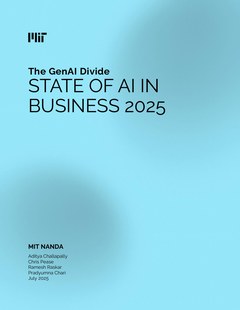
Cover of the MIT NANDA report The GenAI Divide: State of AI in Business 2025 Read the full report The GenAI Divide: State of AI in Business 2025 MIT NANDA. Challapally, Pease, Raskar and Chari. 300+ public AI initiatives, 52 organisation interviews, 153 senior leaders surveyed. Download the PDF ↓

Four stories bring these findings to life. Two are public cases of AI that stalled. Two come from class at The Valley, from companies that got it under control.

Two that stalledPublic cases
Klarna
The chatbot that never learned. Klarna said its AI assistant did the work of 700 customer service agents. It was judged on cost, not on whether it got better with each conversation. A year later the CEO admitted quality had dropped, and Klarna started hiring people again. Finding 01 · The learning gap
McDonald’s
The pilot that never reached production. McDonald’s tested AI voice ordering with IBM in about 100 restaurants for more than two years. It had a clear bar to hit, but accuracy never got there, and the test ended in 2024. Two years is a long pilot. Finding 05 · Measure it, and move fast
Two that got it under controlFrom class at The Valley
Global insurer
The insurer that found its shadow AI. Teams across a global insurer had quietly built dozens of AI agents, with no one seeing the whole. It brought them into the open: one inventory, one set of rules, one owner per agent. Finding 04 · A shadow AI economy
Global agency
The agency that priced every agent. A global advertising agency added the running token cost, in dollars, to its internal agents. Account managers now see what the AI work on each client costs and manage it like any other line in the budget. Finding 03 & 05 · Know where the money goes, and measure it

Across all four, the model was never the problem. What made the difference was whether the AI could learn, whether anyone owned it, and whether its cost and results were on the table.

We never launch a campaign without a budget and a KPI. Why do we launch agents without one?
Sources MIT NANDA: The GenAI Divide, State of AI in Business 2025 (full report, PDF, Jul 2025) Computing: MIT report finds 95% of corporate generative AI pilots fail to deliver returns (Aug 2025) Virtualization Review: MIT report reveals the GenAI divide (Aug 2025) Entrepreneur: Klarna is hiring customer service agents after AI couldn’t cut it (May 2025) Nation’s Restaurant News: McDonald’s is ending its AI drive-thru test with IBM (Jun 2024) The insurer and agency examples come from a class at The Valley.