A prompt is a brief.
Write it like one.
What Google’s AI certification taught me about prompting: persona, context, task and format.

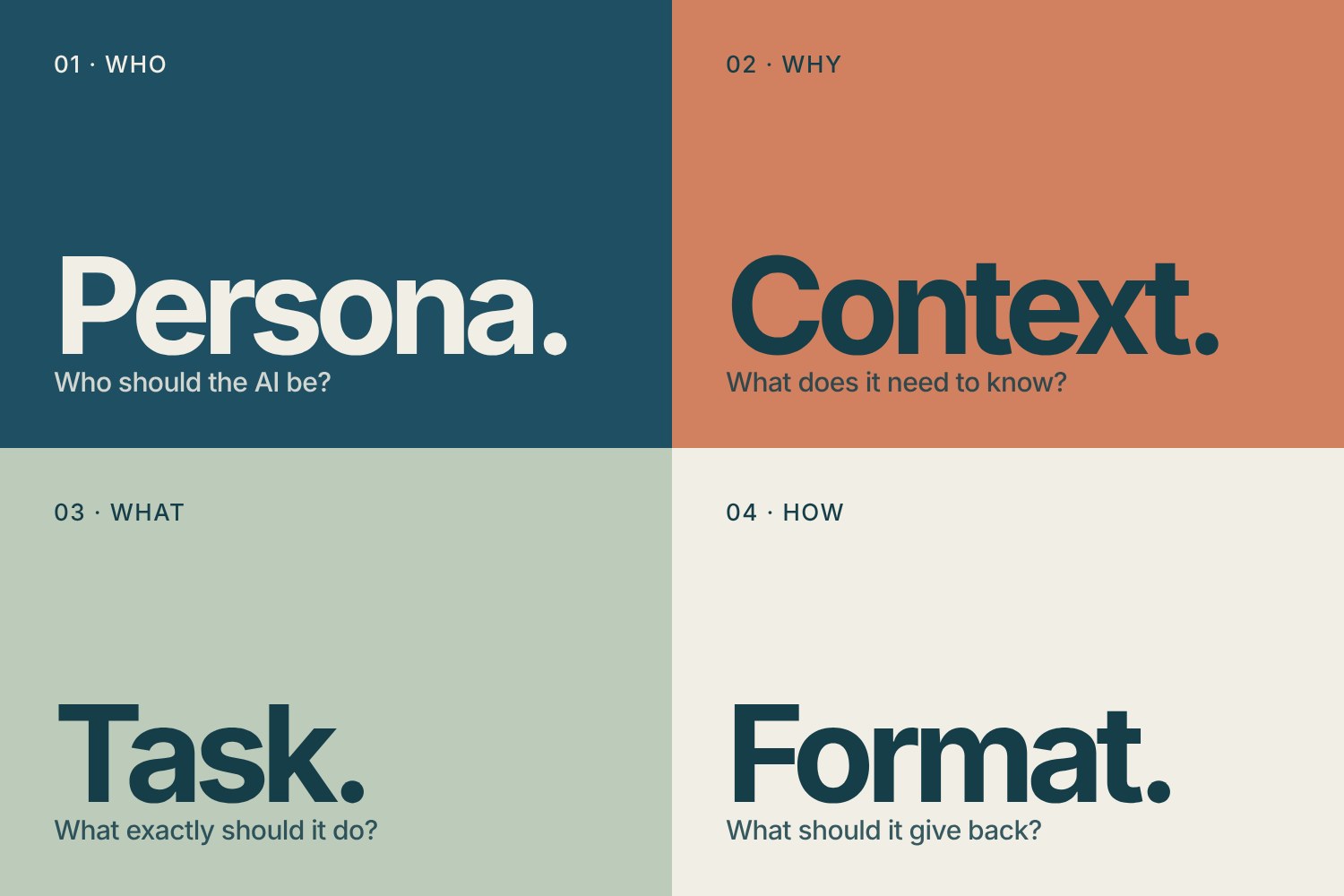
When I took the Google AI certification, the lesson that stayed with me was not technical. It was about briefing. After years of writing briefs for agencies, I recognised the problem straight away: most bad AI output comes from a bad brief.
Google’s own prompting guide for Gemini breaks a good prompt into four parts. You don’t need all four every time, but the more you give, the less generic the answer.
- 01Persona: who should the AI be?Give it a role. “You are a senior brand manager for a premium juice brand” gets a very different answer from no role at all.
- 02Context: what does it need to know?The audience, the brand voice, the goal, the constraints. Google’s advice is to provide as much context as possible. This is where most of the quality comes from.
- 03Task: what exactly should it do?Start with a clear verb: write, summarise, compare, rewrite. One task per prompt works better than five.
- 04Format: what should it give back?Bullets, a table, three options, under 40 words. If you don’t say it, you’ll spend the next prompt fixing it.
Before: “Write a post about our new juice.”
After: “You are a senior brand manager for a premium juice brand in Spain. Our audience is urban professionals aged 25 to 40 who care about natural ingredients; the voice is warm and confident; the launch is in March. Write three Instagram captions to launch our new citrus and ginger blend. Keep each under 40 words, end with a call to action, and show them in a table with hook, body and CTA.”
Persona · Context · Task · FormatThe certification adds two habits on top. First, give the AI references to work from, such as a brand guide, past campaigns or data. Second, evaluate and iterate: the first answer is a draft, not a deliverable. The course packs it into five steps: task, context, references, evaluate, iterate.
And length is not the point. In Google’s early Workspace tests, the most successful prompts averaged around 21 words. Good prompts are not long. They are complete.
If you briefed your agency the way you prompt your AI, what would you get back?